
Essential services
Everyone has the right to water, sanitation & clean energy
Water and sanitation
Even in the tropical Top End, but especially in Central Australia, many Aboriginal people lack reliable access to clean drinking water.
The NT Government provides water to the four urban centres and 73 remote communities. For community living areas and homelands, there is usually a bore, which may be run on mains power, solar or a diesel generator. Some of these more remote places also have rainwater tanks.
Power
Energy security is a major issue for Aboriginal Territorians, especially in solar hotspots such as the Barkly, and especially given global warming.
In public housing, there is no program to convert electricity systems to solar, or to include rooftop solar panels as part of a standard new build.
Original Power is working hard in the Territory to demonstrate the possibilities of clean energy in homelands, townships and in public housing. The below video is a beautiful example, focused on the Borroloola solar communities project.
In 2022, with the help of Origin Mob’s rooftop solar trial, Tennant Creek resident Norman Frank Jupurrurla found his way through tricky political and regulatory terrain to become the first public housing tenant in the NT to get rooftop solar power. He also proved that it can work with a prepaid meter system.
In 2023 as part of the Alice Springs Future Grid project, 15 public houses will get rooftop solar. The engineering company doing the work has a long association with renewable energy in the Northern Territory. It is the wholly-owned subsidiary of the Centre for Appropriate Technology (CfAT).
Energy enables
Between 2002 and 2013 CfAT ran the hugely successful Bushlight program.
The Australian Government is developing a First Nations Clean Energy Strategy, so right now there’s an opportunity to influence energy systems for Aboriginal housing in the Territory.
Data
One major obstacle to achieving goals under Closing the Gap is that for many targets there is no reliable source of data. In relation to homelands, AHNT has started to collect our own data, including in relation to water and energy security. It’s a small set, so far, but it already yields some important insights.
Readings related to water, sanitation and power
-
Contributing to the federal strategy for First Nations clean energy
The federal Department of Climate Change, Energy, the Environment and Water is developing a First Nations Clean Energy Strategy.
-
Report of the 2023 Remote Housing and Homelands conference
Report, recommendations and next steps after the AHNT-hosted Remote Housing and Homelands conference held 18 to 20 April 2023 in […]
-
NTCOSS on the national energy strategy
On 7 February 2023 NTCOSS sent this response (PDF 180kb) to the Australian Government’s proposed strategy around national energy performance. […]
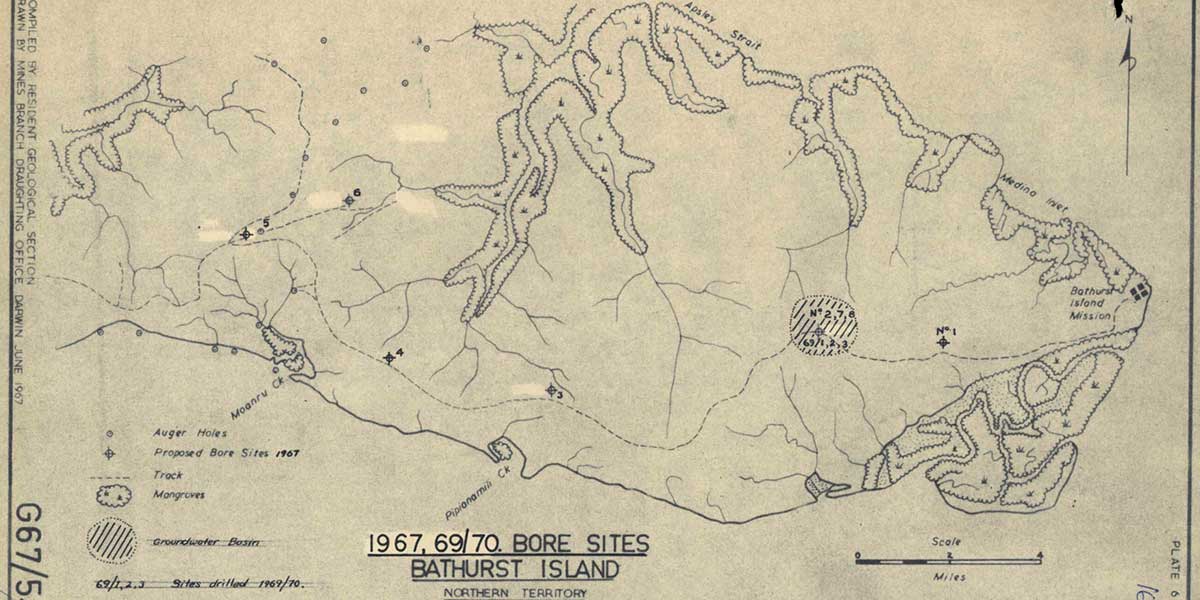
Image credit: Map showing prospective bores on Bathurst Island. National Archives of Australia: F1, 1968/1110, p27